From review to new gallery
Sample plan · from the dish-rack review
Now (from the review)
- 1PartlyMain: filled rack
- 2PartlySpout turns
- 3PartlySize on white
- 4PartlyClose-ups
- 5YesWhat goes where
- 6YesBefore / after
- 7YesUnder cabinets
- ?NoAssembly
Paid set
- 1PlannedRack on white
- 2PlannedReal size (new)
- 3PlannedCounter fit
- 4PlannedSpout reach
- 5PlannedCapacity, in numbers
- 6PlannedAssembly (new)
- 7PlannedUnder cabinets
- ×DroppedBefore / after: dropped
This is what you approve before a single image is made: every slot, its buyer question, the exact text and the reason it’s there.
The paid step after my free sample review: a new 7-image gallery for the same dish rack. I left out the brand. The wireframes below are my own drawing, with no product photos. Numbers I don’t have are in [brackets]: in an order, they come from your spec or manual, and nothing goes on an image until you confirm it.
What the review found
- Size is the only review topic where negative mentions outnumber positive ones: 165 of 297. One review says: “What doll house dishes were used in the product photo?”
- Assembly has 122 negative mentions of 316, and none of the 7 images shows it.
- Five of the seven images show the same filled rack. Only slot 7 uses ordinary kitchen things, so in my reading it’s the only one where you can see how big the rack is.
- No numbers where buyers want them: how many dishes fit, how far the spout reaches.
- The main image is a kitchen scene, while Amazon’s rules ask for a pure white background.
Now and in the paid set
- Two new slides: real size with everyday dishes (2) and assembly (6).
- Folded in: the spout and the close-ups become one slide with the reach in inches (4). The drip tray stays; the “without residue” promise goes.
- Dropped: before / after. It was the fifth image of the same filled rack, and slot 7 already shows a real-looking kitchen. My call.
What finished slides look like
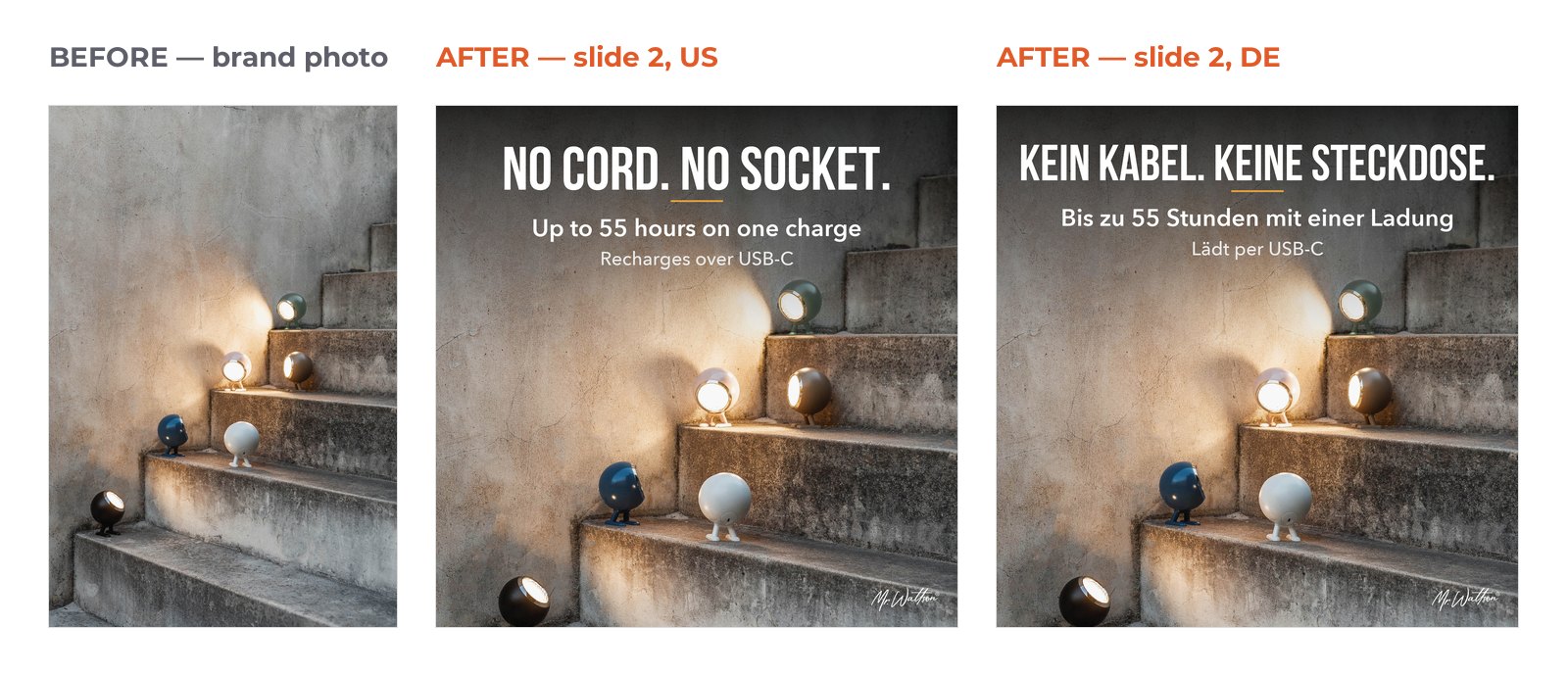
The 7 slots
Text in quotes is the exact text on the image. “Fix 1–3” are the 3 changes the review put first.
-
Slot 1 · main image
“Is this a 2-tier counter rack?”
- On the image
- No text
- The photo
- Your own photo or render of the rack alone, on pure white, large in the frame: both tiers, the drain tray and spout, the cup and utensil holders. Nothing in it is AI-generated.
WhySlot 1 was a kitchen scene. My call: the main image shows only the product, so the size question moves to slot 2, where there’s room for it.
-
Slot 2 · real size · new
“How big is it really? Will my plates fit?”
- Headline
- “Real size, next to everyday dishes”
- Callouts
- “Top tier: plates up to [plate size from your spec]” · “5.5 in gap: [what fits, from your spec]”
- The photo
- The rack with everyday dishes, not a matching set: a standard dinner plate in the top tier, a bowl and a cup in the lower tier. Whether the plate fits comes from your spec; if it doesn’t, the image shows that too.
WhyThe symptom: size, 165 negative mentions of 297. Slot 3 never said what fits in the 5.5 in gap; one review says “there’s not enough room between the bottom and top for my plates”. Fix 1.
-
Slot 3 · counter fit
“Will it fit my counter?”
- Headline
- “Takes a 16.5 × 11.9 in spot on your counter”
- Callouts
- “12.75 in tall” · “5.5 in between tiers”
- The photo
- The rack on white with dimension lines, using the numbers on the current slot 3: 16.5 × 11.9 × 12.75 in, 9.45 in top tier, 5.5 in between tiers.
WhySlot 3 gave the footprint but not what fits in the gap (now slot 2). The page’s Product Dimensions say 6 × 10 × 8 in, so only the numbers you confirm go on the image.
-
Slot 4 · spout reach
“Will the water go into my sink, or onto my counter?”
- Headline
- “Spout reaches [spout reach from your spec] past the tray”
- Callouts
- “Turns 360°” · “Funnel-type drip tray”
- The photo
- Side view at a sink edge: the tray on the counter, the spout over the sink, a line from the tray edge to the spout tip labelled “[spout reach]”. So you see how close to the sink the rack has to stand.
WhySlot 2 showed the spout turns, but no image gave its length; one review says it “barely makes it to the sink”. Slot 4 promised “drain water without residue”, and one review says “not all water drains”, so the new slide doesn’t say it. Fix 3.
-
Slot 5 · capacity
“How many dishes does it hold?”
- Headline
- “Holds [N] plates, [N] bowls and [N] cups”
- Callout
- “Spots for cups, knives and forks, and a chopping block”
- The photo
- The rack loaded with everyday dishes, a count badge on each group. The three [N] come from your spec.
WhySlot 5 showed what goes where, without numbers. Capacity: 58 negative mentions of 258. All 3 competitors put capacity into words or numbers. Fix 3.
-
Slot 6 · assembly · new
“How do I put it together?”
- Headline
- “How it goes together, step by step”
- Callouts
- “Bracket hooks face outward” · “Top tier: [how it fits on, from your manual]”
- The photo
- 3–4 numbered panels, drawn from your manual and photos of each part, with the bracket-hook step shown large.
WhyAssembly: 122 negative mentions of 316, and no slide. The seller’s own tip, which way the bracket hooks face, is in the description, not in a picture. One review says: “A little tricky getting the top layer installed”. One competitor shows how the parts fit together; another shows the parts in the box. Fix 2.
-
Slot 7 · under cabinets
“Will it fit under my cabinets?”
- Headline
- “Under wall cabinets, leave [clearance from your spec]”
- Callout
- The line from counter to cabinet, labelled “[clearance]”
- The photo
- A real-looking kitchen, like the current slot 7: an everyday saucepan on top, a bowl and a cup below, wall cabinets above.
WhySlot 7 is the only photo with ordinary kitchen things, so I keep the idea. But “≥22in” didn’t say whether that’s the clearance you need or just this kitchen. My call: this slot also does the “tidier kitchen” job, so the before / after slide goes.
Wireframes
My own drawing, one tile per slot. Grey boxes stand for what the photo shows; dark text is the text on the image; [brackets] are numbers you’d confirm. No product photos, no AI images.
-
cupsknives, forksspout
1Main image · pure white, no text
-
Real size, next to everyday dishes
dinner platebowlcupTop tier: plates up to [plate size from your spec]
5.5 in gap: [what fits, from your spec]
2Real size · everyday dishes, not a matching set
-
Takes a 16.5 × 11.9 in spot on your counter
12.75 in tall
5.5 in between tiers
16.5 in
3Counter fit · only the numbers you confirm
-
Spout reaches [spout reach from your spec] past the tray
Turns 360°
Funnel-type drip tray
[spout reach]
countersink4Spout reach · side view at the sink edge
-
Holds [N] plates, [N] bowls and [N] cups
plate×[N]bowl×[N]cup×[N]Spots for cups, knives and forks, and a chopping block
5Capacity · counts from your spec
-
How it goes together, step by step
1[step from your manual]2Bracket hooks face outward3Top tier: [how it fits on, from your manual]4[step from your manual]6Assembly · number and order of steps from your manual
-
Under wall cabinets, leave [clearance from your spec]
wall cabinetssaucepancounter[clearance]
7Under cabinets · a real-looking kitchen, everyday things
What images can’t fix (I say it up front)
- Product Dimensions that don’t match. The page says 6 × 10 × 8 in; slot 3 says 16.5 × 11.9 × 12.75 in. That’s listing data, so you fix it in the listing attributes. The images use the numbers you confirm.
- The spout’s length. A longer spout is a product change. Slot 4 shows the real reach, whatever it is.
- How hard assembly is. Slot 6 shows the tricky steps; it can’t make the design simpler.
What you get
Your product is never redrawn: it’s placed from your own photos or renders. Text is typeset, never generated, and every number is checked against your listing. Where AI builds a scene, a code check confirms the product’s pixels are unchanged.
Before the final files: the written scenario (this plan, with every [bracket] filled) and 1–2 wireframes of key images for your approval.
Then one ZIP file for the ASIN:
- 7 final images, PNG, full resolution
- The approved English brief
- Alt texts for every image
- An upload map: which file goes into which slot
- A file list with checksums, proof the files weren’t changed
- A one-page QC report
You upload the files to Seller Central; the upload map shows where each one goes. Gallery only, or gallery + A+ Content. Price per ASIN, quoted after the free review and fixed before work starts.
What I need from you
- Photos or renders from 2000 px: all angles and a close-up of each part. The rack comes in parts, so I need large photos of each part: that’s my condition for products you assemble.
- Photos of the rack with real, everyday dishes for slots 2, 5 and 7. Dishes inside the rack cover the product, and I don’t change product pixels. If you don’t have such photos, you get a short reshoot brief.
- The manual, for the steps on slot 6.
- The numbers in [brackets], and which dimensions are right: 16.5 × 11.9 × 12.75 in or 6 × 10 × 8 in.
- Brand kit: vector logo, colors, and the font with its license.
Start with a free review of your listing. Send an ASIN, the marketplace (for example amazon.com or amazon.de) and an email: free, within 2 working days. If you want the images after it, I quote the set per ASIN: gallery only, or gallery + A+ Content.
Get my free review Rather talk first? Book a 30-minute callHow this was made: a plan written on 21 Oct 2026 from my sample review of the same listing (desktop amazon.com, page checked 20 Oct 2026, viewed from Denmark). No new images were made. Review counts and quoted reviews come from Amazon’s AI review summary as displayed on 20 Oct 2026. Numbers in brackets aren’t on the public page; in an order, they come from your spec or manual. The wireframes above are my own drawing, not the seller’s images and not AI images.